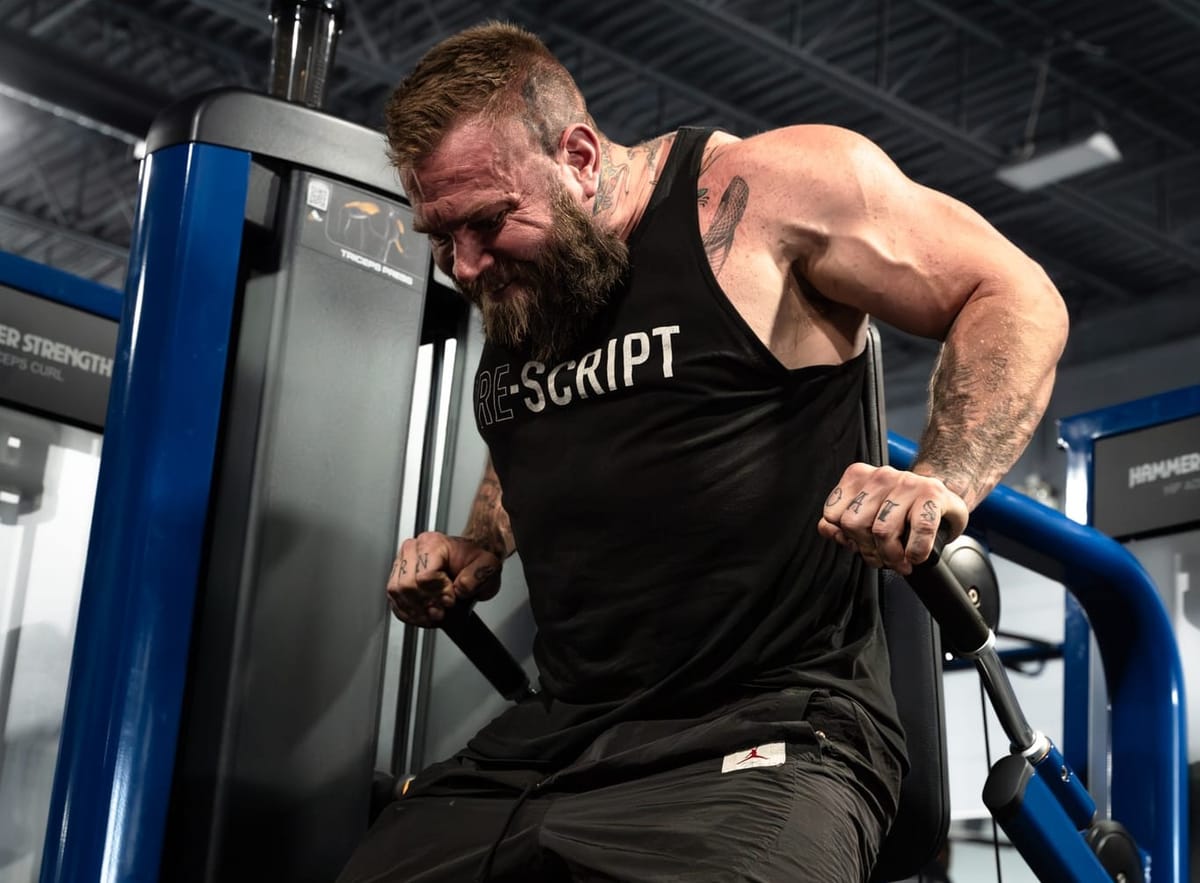
Adjusting arm path alone is insufficient to properly bias the costal fibres of the pectoralis major.
Muscular development of the pectoralis major group is a central goal of conventional aesthetic hypertrophy training. But for many, this training outcome remains elusive. Now, there are a number of reasons why muscles might not develop – lack of sleep, improper nutrition, and substandard exercise intensity, to name a few.
But even in cases where people have their training and nutrition ducks in a row, they can struggle with the specific development of what's known as the “lower” or “costal" division of the pec. And oftentimes, fixing it comes down to one key execution cue.
Conventional wisdom emphasizes shoulder trajectory, but overlooks pec origin stability during eccentric loading.
It’s obvious to most that one of the determining factors of successfully targeting a specific region of the pec comes down to arm path:
- For “upper pec” (clavicular), the arm path starts low, and finishes high – such is the case with the dumbbell incline press.
- For “middle pec” (sternal) the arm path remains more horizontal – such is the case with flat pressing and fly variations.
- And for “lower pec” (costal), the arm path starts high, and ends low – such is the case with dips, decline press, and high to low cable flys.
This approach is widely accepted in training circles, but when it comes to the lower pec, this approach is uniquely incomplete.
Let's dive in.
The lower pec is defined by those fibres that originate on the lower aspect of the anterior ribcage. And it's this anatomical feature that makes the conventional approach unique and potentially ineffective.
When people are performing high to low cable flys, decline presses, and dips, they tend to attempt to exaggerate the "stretch" by bringing their chest up as the shoulder stretches the pec in its lengthened position. For most people, the more the shoulder goes back, the higher the chest comes, and the more the ribcage flares as a byproduct.
This ribcage flare decreases the effectiveness of decline pressing for reasons that should be quite obvious.
Ribcage flaring causes concurrent origin and insertion displacement, eliminating net muscle lengthening.
In order for a muscle to increase its tension in the stretched position, one end of the muscle has to be fixed, but in the case of lower pec movements, this principle is completely disregarded. If the ribs are flaring as the shoulder goes into extension, the net length of the costal fibres of the pectoralis isn't changing. It's simply staying the same, as both the origin and the insertion move in the same direction.
So what's the solution?
The core.
The obliques and rectus abdominis are the keys to lower pec development, and they are so often neglected.
When we execute these movements, we tend to hyper-fixate on stretching the pec from the shoulder, and we forget about anchoring the lower ribs. When we use the obliques and the rectus abdominis to draw the lower ribs down towards our pelvis, we will seemingly cut the range of motion of the movement at the shoulder. But what we’re actually doing is allowing the lower pec to stretch at the insertion as the origin on the ribs stays stable.
At the end of the day, there is a difference between the range of motion of a muscle and the range of motion of a joint.
The range of motion at the shoulder is not a direct indicator of the stretched position of the pec if the lower ribs aren't accounted for.
So, where does this leave us?
Core engagement and strategic exercise selection increases costal pec stimulation through fixed rib positioning.
With this knowledge in hand, we can make two meaningful considerations that will lead to big changes in lower pec development:
${component=Step}Stay Stacked: Engage the core to anchor the lower ribs.
Engaging your core and tucking your lower ribs down is an immediate correction that most people can make on all of their lower pec movements that will make a considerable difference in their ability to target the muscle effectively. Keep in mind, this newfound technique may force you to use lighter loads as you learn to integrate this technique. But don't fret – even though the weight might be lighter at first, the stimulus to the pec will be far more effective.
${component=Step}Program More Effectively: Match exercise selection to ribcage control ability.
For some, the ability to control the lower ribs can be directly correlated to the exercise they choose. Bodyweight or loaded dips, for example, can be particularly tricky for a more novice lifter to control their ribcage on. So, consider an assisted dip or machine dip variation where the pelvis and ribs can be more easily contained – this might be a better choice of exercise in order to learn this new technique.
The Final Word:
More shoulder extension doesn't help lengthen the lower pec unless the ribs are fixed.
Most people assume that if some stretch is good, more stretch is better. That simply isn't the case. Lengthening a muscle helps to grow it, but only if you can effectively apply tension. In this case, chasing more length in the lower pec by moving the ribcage doesn't increase the length of the muscle, and therefore does not cause any increase in meaningful tension. In order to get the most out of your lower pec movements, fix the origin in place by engaging the obliques and rectus abdominis and then allow the shoulder to extend and abduct.
The lower pec is commonly deemed a "stubborn" muscle group because of how difficult many lifters find growing it. The truth is, "stubborn" muscle groups are great learning opportunities – they're a chance to strip things back to the basics and evaluate your approach critically. The lesson of the lower pec about understanding origin, insertion, and effective tension can be translated over into other stubborn muscles. Proper technique based on first principles of biomechanics and an analytical approach to exercise selection are always your first line of defence when attempting to grow a muscle.